
- 26 January 2024
- Av. Köksal YILDIRIM
- Publications
EXPROPRIATION AND EMERGENCY EXPROPRIATION
INTRODUCTION
The state is undoubtedly the most comprehensive and most empowered legal entity. The reason for the state's existence is to provide services that ensure the peaceful and secure living of the people residing on its territory. In fulfilling these duties, the state must utilize certain legal institutions to use the material resources at its disposal in a necessary manner, based on the superior powers granted to it or used by the administration. One of these institutions is "expropriation." [1]
Expropriation is an administrative procedure whereby real estate owned by natural persons and private legal entities is acquired by the State and public legal entities and/or an easement right is established on it, when required in the public interest. Expropriation finds its basis in Article 46 of our Constitution. The relevant article states that "the State and public legal entities are authorized to acquire all or part of immovable property in private ownership, in cases where the public interest so requires, provided that the actual compensation is paid in advance, in accordance with the principles and procedures specified by law, and to establish administrative easements thereon." This provision provides a constitutional basis for expropriation, and the procedures and principles of expropriation are regulated by the Expropriation Law No. 2942.
Parallel to Article 46 of the Constitution, Article 3 of the Expropriation Law No. 2942 regulates the conditions for expropriation; accordingly, expropriation covers real estate, resources, and easement rights necessary for the performance of public services or undertakings for which the authorities are responsible, and is subject to the condition that their prices be paid in advance or in equal installments as specified in the law.
THE CONCEPT OF PUBLIC INTEREST
First, it is necessary to address the concept of "public benefit." Just as it constitutes the purpose of all administrative activities, "public benefit" is also a condition for expropriation. However, despite its frequent use in both constitutions and laws, the concept of public benefit has not been fully and precisely defined.
In a narrow and technical sense, public benefit falls within the scope of administrative law and constitutes the "purpose" element of administrative actions, meaning that administrative actions must be carried out in a manner that meets the needs of society, within the framework of the principles of equality and impartiality. In a broad sense, when choosing between personal benefit and public benefit, either a quantitative choice between benefits will be made (sacrificing the benefit of the minority in exchange for the benefit of the majority) or a qualitative choice will be made (preferring the very important benefit of the minority over the less important benefit of the majority). [2]
With these explanations, public interest can be briefly defined as the balance that can be established between individual and collective interests in society. [3] The "public interest," which constitutes the purpose element of all other activities of the administration, constitutes both the cause and the purpose element of expropriation. In other words, in expropriation, which is an administrative act in terms of its legal nature, the elements of "cause" and "purpose" are the same, and this is the public interest.
The purpose of the expropriation process is to establish public benefit by using the expropriated real estate in the performance of a public service. Therefore, the elements of "cause" and "purpose" are intertwined in expropriation. In this sense, "public benefit" is an indispensable condition of the administrative act of expropriation. [4]
STAGES OF THE EXPROPRIATION (EMPLOYMENT) PROCEDURE
ADMINISTRATIVE STAGE
Securing Sufficient Funds for Expropriation (Article 3 of the Expropriation Law)
The last paragraph of Article 3 of the Expropriation Law No. 2942 states that "expropriation proceedings cannot be initiated without sufficient funds being secured by the authorities," thus regulating the "securing of sufficient funds" as a prerequisite for initiating expropriation proceedings.
At the same time, the first paragraph of Article 3 states that the authorities may expropriate real estate whose expropriation has been decided "by paying the value in cash and in advance or, in the cases specified below, by paying in equal installments." This means that the administration or public legal entity is required to pay the compensation for the real estate to be expropriated in advance, and in certain cases, the expropriation may also be carried out in equal installments.
In cases where payment is to be made in installments, the amount to be paid in advance must be secured and provided for in the budget. The amounts corresponding to other installment payments spread over several years must also be secured in accordance with the procedures and principles relating to the budget. [5]
Public Interest Decision (Article 5)
The administration must make a public interest decision after securing sufficient funds. A public interest decision is a decision made by the administration that there is a public interest in the performance of a specific task that constitutes a public service. A public interest decision is essentially a permit granted to the administration to acquire real estate. [6] It is essential that this decision be made prior to expropriation.
Article 5 of the Expropriation Law No. 2942 separately regulates the authorities that can make public interest decisions for expropriations in favor of public administrations, public institutions, and private individuals. The public interest decision taken by the authorities listed in the article must also be approved by the authorities listed in Article 6 of the same law. However, public interest decisions issued by the President or ministries do not require additional approval. No additional public interest decision or approval is required for services to be performed in accordance with an approved zoning plan or a special plan and project approved by the relevant ministries. In such cases, a decision indicating that the expropriation process has been initiated is taken by the competent executive body.
Identification of the Real Estate to be Expropriated and Placement of an Administrative Note (Article 7)
The stage following the public interest decision is the identification of the real estate to be expropriated. According to Article 7 of the Law, the administration carrying out the expropriation prepares or has prepared a scaled plan showing the boundaries, area, and type of the real estate or resources to be expropriated; identifies the owners of the expropriated real estate, or if there is no title deed, the possessors and their addresses, by means of title deeds, tax and population records, or by conducting additional external research and documenting the findings. The administration takes an "expropriation decision" for the identified real estate.
After the administration has made the expropriation decision, it notifies the land registry office where the real estate subject to expropriation is registered to have the expropriation annotated in the land registry. If the document obtained from the court stating that the administration has requested the determination of the expropriation price and registration in the name of the administration in accordance with Article 10 of the Law within 6 months from the date of the annotation is not presented to the land registry office, this annotation shall be deleted from the registry ex officio by the land registry office. [7]
Purchase Procedure (Expropriation Law Article 8)
After the administration has made the expropriation decision and this situation has been recorded in the land registry, it must first apply the purchase procedure. The administration carrying out the expropriation appoints one or more valuation committees consisting of at least three persons from within its own structure to determine the estimated value of the real estate property in accordance with the principles set forth in the law. [8] [9] In addition, the authority appoints a settlement committee of the same size to conduct purchase and exchange transactions through negotiation based on the appraised value.
The administration then, without specifying the estimated value, notifies the owner in writing, with official undertaking, of its intention to purchase by negotiation (in return for payment in advance or, where applicable, by installments in accordance with Article 3) or to acquire by exchange with another immovable property belonging to the administration, in accordance with the procedures set forth in the law.
If the owner or authorized representative applies to the administration within 15 days from the date of notification of this letter, requesting to sell the real estate subject to expropriation by negotiation and agreement or to exchange it, negotiation discussions shall be held. If an agreement is reached on the price or exchange not exceeding the estimated value determined, minutes are drawn up and signed by the owner or authorized representative and the commission members. These minutes constitute the owner’s declaration of transfer and the legal basis for registration in the name of the administration.
Within 45 days at the latest from the date of preparation of the agreement minutes, the administration shall prepare the amount specified in the minutes and, based on the minutes and the letter stating that the real estate has been cleared of all encumbrances and rights prior to expropriation, registration or cancellation shall be made ex officio in the name of the administration in the land registry. After this, the expropriation compensation is paid to the right holders.
Real estate, resources, or easement rights purchased or exchanged in accordance with this article shall be deemed to have been acquired from the owner through expropriation, and no objection proceedings may be brought against such expropriation or its compensation. In the absence of an agreement or waiver, the provisions of Article 10 of this Law shall apply.
JUDICIAL STAGE
At the end of the administrative stage, if the owner grants a deed of transfer at the land registry office for the transfer of the expropriated real estate to the administration, the expropriation process is completed and the ownership of the real estate passes to the administration. However, if the owner does not grant a deed of transfer, the expropriation process is carried out by a court decision at the end of the judicial process. At this stage, since the expropriation process will be heard in the civil courts of first instance, it will be considered a judicial stage. [10]
Determination of the Expropriation Compensation by the Court and Registration of the Real Estate Property in the Name of the Administration (Expropriation Law Article 10)
If expropriation cannot be carried out by purchase, the administration submits a petition to the civil court of first instance where the real estate is located, attaching the information and documents it has collected, the compensation determination it has made, and other information and documents, requesting that the expropriation compensation be determined and that the real estate be registered in the name of the administration in exchange for payment of this compensation in cash or in installments.
At the hearing held on the date set by the court, the judge invites the parties to reach an agreement on the price of the real estate. If the parties agree on the price, the judge accepts this agreed price as the expropriation price; if the parties cannot agree, the judge sets a date for an on-site inspection within 10 days at the latest and a hearing date 30 days thereafter, and conducts an on-site inspection to determine the value with the assistance of experts and in the presence of all interested parties. The village or neighborhood headman is also invited, and their statement is taken.
If the parties still cannot agree on the price, a new panel of experts is appointed by the judge, if necessary, to reach a conclusion within 15 days, and the judge determines a fair and equitable expropriation price based on the reports and statements.
If the parties agree, the agreed amount is deposited in cash in advance into a bank account in the name of the right holder. If the parties cannot agree, the administration is given 15 days to deposit the amount determined by the judge into the bank account specified by the court and to present a receipt. If expropriation is carried out in installments, the first installment is likewise deposited in advance.
Where necessary, this period may be extended by the court on a one-time basis. Upon presentation of the receipt confirming the deposit, the court decides on registration in the name of the administration and payment of the compensation to the right holder, and notifies the land registry office and the bank.
The registration ruling is final, and the parties’ rights to appeal regarding the compensation amount are reserved. If the finalized amount is less than the amount paid in advance, the difference is claimed from the relevant party; no interest is charged for the period between the payment date and the date of notification regarding repayment.
If the lawsuit is not concluded within 4 months, statutory interest is applied to the determined compensation from the end of this period. If the expropriated immovable property becomes of a nature that does not require registration in the registry in terms of the public service to which it is assigned, the court decides to cancel the registry entry upon request. [11]
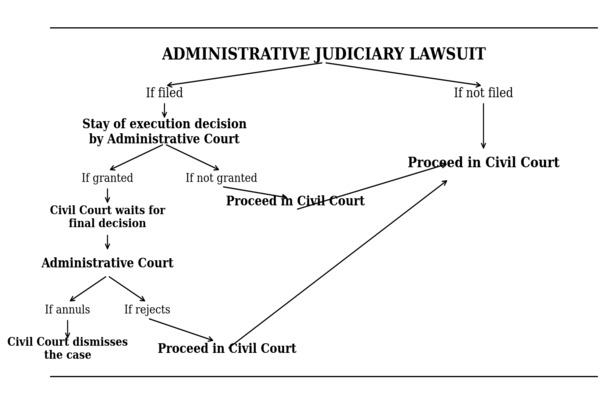
If the owner files an annulment lawsuit within 30 days and the administrative courts decide to suspend execution, the court treats the administrative lawsuit as a pending issue and proceeds accordingly.
Right of the Owner to File a Lawsuit in Administrative Courts (Articles 10-14)
According to Article 14 of the Expropriation Law No. 2942, the owner may file an annulment lawsuit in the administrative court against the expropriation process and a correction lawsuit in the judicial court against material errors within thirty days from the notification or publication made in accordance with Article 10.
If the owner does not file an annulment lawsuit in administrative courts, the proceedings in the civil court of first instance continue under Article 10. If the owner files an annulment lawsuit, the civil court proceedings continue unless a stay of execution is granted; if a stay is granted, the civil court must suspend proceedings pending the administrative court’s decision.
On the merits, if the administrative court rejects the case, civil proceedings continue. If the administrative court annuls the expropriation, the civil court also rejects the determination and registration lawsuit, and the expropriation process ends.
CONSEQUENCES OF COMPLETING THE ADMINISTRATIVE AND JUDICIAL STAGES
In terms of the exercise of rights and the fulfillment of obligations, the expropriation process is completed for the property owner with the registration decision issued by the court in accordance with Article 10 of Law No. 2942.
From the date of the registration decision, the owner loses the rights to use the real estate (e.g., constructing new buildings or planting crops, or making substantial changes to existing buildings). The value of any subsequent actions is not taken into account.
AFTER EXPROPRIATION
Unilateral Withdrawal by the Administration
Article 21 of the Expropriation Law No. 2942 states that the administration may unilaterally waive the expropriation in whole or in part at any stage with the decision of the competent authority that issued and approved the expropriation decision. In the event of withdrawal during the lawsuit, the court determines attorney’s fees to be borne by the administration, considering costs, fees, labor expended, and the importance of the work.
Withdrawal and Transfer by Agreement of the Parties
After the expropriation becomes final, if there is no longer any need to allocate the real property for the purpose of expropriation or for any public benefit, the administration notifies the owner or heirs. They may reclaim the property within three months by repaying the compensation plus statutory interest (no interest if return occurs within one year after finalization).
If the owner or heirs do not accept return under this article, their right under Article 23 also lapses; these provisions do not apply if five years have passed since finalization.
Where another administration wishes to acquire the property for a public service, the procedure is carried out under Article 30 of the Law or the relevant public finance framework. (Law No. 1050 was repealed; references are deemed to be made to Law No. 5018). [12]
Accordingly, if another administration is willing to carry out a public service through expropriation, the procedure is carried out in accordance with Article 47 of Law No. 5018. [13]
The Owner's Right of Redemption
Article 23 lists the conditions under which the owner or heirs may reclaim the property within five years from finalization of the compensation, by repaying the compensation plus statutory interest from the date of receipt:
- No actions or installations are made in line with the purpose of expropriation and transfer.
- The property is not allocated for a public need and is left as is.
The right of redemption lapses if not exercised within one year of its accrual.
TRANSFER OF PUBLIC REAL ESTATE TO ANOTHER ADMINISTRATION
Under Article 30 of Law No. 2942, immovable property, resources, or easement rights owned by public legal entities and institutions cannot be expropriated by another public legal entity or institution. The administration in need follows the pricing and application steps described, and disputes are resolved by the Council of State, with judicial pricing if needed.
EXPROPRIATION BY TRADE-OFF
Under Article 26 of Law No. 2942, if the owner agrees, the administration may provide real estate not allocated for public service in lieu of cash compensation, provided the value does not exceed 120% of the expropriation compensation, and differences are paid in cash. The process remains administrative unless the owner rejects it, in which case the judicial stage follows. [14]
CONDITIONS
Acceptance of Exchange by the Property Owner
The owner must consent; the administration cannot unilaterally force expropriation by trade-off.
The Real Estate Subject to Exchange Must Not Be Allocated for Public Service
The real estate offered by the administration must not be allocated for public service.
Determination of Value and Not Exceeding 120% of the Expropriation Value
The value of the real estate to be provided must not exceed 120% of the compensation; the law leaves no discretion. The provision does not specify how much higher the compensation must be than the administration’s real estate value. [15]
Payment of the Difference Between Values
Differences are paid in cash by the parties; if unpaid, the process cannot be completed. [16]
EMERGENCY EXPROPRIATION
The urgent expropriation procedure is an extraordinary method allowing the administration to seize the property without waiting for completion of the full process; it requires a superior public interest, especially where an urgency decision exists. [17]
Except for valuation, other procedures may be completed later; upon request, the court determines value within seven days, and the administration may seize the property by depositing the value into a bank account in the owner’s name.
This procedure does not eliminate safeguards; after seizure, the administration must first attempt purchase, and if not possible, file a lawsuit for determination and registration. [18]
Article 27 addresses national defense or extraordinary circumstances; the Council of State emphasizes that emergency expropriation is exceptional and requires concrete urgency and strong public interest/public order justification in each case. [19]
The Council of State also notes that public interest may prevail over property rights in this exceptional context, but emergency expropriation cannot be justified solely by procedural length, and should not be assessed only economically. [20] [21] [22] [23]
While recent decisions show some relaxation, a very high level of public interest is still required. [24]
CONCLUSION
The relationship between "expropriation, urgent expropriation, and property rights," which came to the fore with the application of Hakan Bilal KUTLUALP [25] published in the Official Gazette on December 14, 2023, has been debated again by lawyers and citizens.
In a state governed by the rule of law, the administration is limited by the concept of "public interest" in all its acts and transactions. Accordingly, the administration cannot act contrary to the public interest in any of its transactions, especially in expropriation and urgent expropriation. Another limiting factor is the right to property under Article 35 of the Constitution; interference must be lawful and based on accessible and predictable rules.
Law No. 2942 sets out expropriation stages step by step, fulfilling the legality requirement for limiting property rights, and the judiciary supervises compliance. It is also incumbent upon legal professionals to convey the procedures, conditions, and alternative methods (trade-off and emergency expropriation) clearly and concisely to all segments of society.
[1] Göven, Yusuf, Kamulaştırma İşlemlerinde “Kamu Yararı”, Dumlupınar Üniversitesi Sosyal Bilimler Dergisi, Sayı 1, Ocak 1999.
[2] Göven, Yusuf, a.g.e./YILDIRIM, Turan, İdare Hukuku, sf. 392 vd., On İki Levha Yayınları, İstanbul 2018.
[3] Yıldırım, Turan, a.g.e., sf. 392 vd.
[4] Göven, Yusuf, a.g.e.
[5] Yıldırım, Turan, a.g.e., sf. 602 vd.
[6] Gözler, Kemal, İdare Hukuku Dersleri, sf. 723 vd., Ekin Basım Yayın, Bursa 2015.
[7] Kamulaştırma Kanunu madde 7/3
[8] “Kamulaştırma bedelinin tespitinde Anayasa hükmüne göre, kamulaştırılan taşınmazın gerçek karşılığının taşınmaz malikine ödenmesi gerektiği belirtilmektedir. Kamulaştırma Kanunu'nda ise, kamulaştırma bedelinin hangi tarih esas alınarak hesaplanması ile ilgili olarak açık bir hüküm bulunmamaktadır. Yargıtay uygulamasında, kamulaştırma bedelinin tespiti için dava tarihinin esas alınması yönünde içtihat birliği söz konusudur. Ne var ki, Yargıtay kararlarında, neden dava tarihinin esas alındığı konusunda bir açıklama ve gerekçe de bulunmamaktadır.” (Anayasa Mahkemesi 2022/83 Esas, 2023/69 Karar)
[9] Kamulaştırma Kanunu madde 8/1-2
[10] Gözler, Kemal, a.g.e., 726 vd.
[11] “Anayasa Mahkemesi 1. Bölümünün 19.12.2013 tarih ve 2013/817 sayılı kararında, kamulaştırma bedelinin tespiti için açılan davada uzun süren bir yargılama sonunda, dava tarihi itibarıyla belirlenen bedele hükmedilmesinin Anayasanın 35. maddesinde güvence altına alınan mülkiyet hakkının ihlal edildiği kabul edilerek mal sahibine tazminat ödenmesi gerektiği belirtilmiştir.
Yasa koyucu da bu hak ihlalini dikkate alarak, 6459 sayılı Kanunun 6. maddesiyle 2942 sayılı Kanunun 10. maddesine eklenen fıkrada (yürürlük tarihi 30.04.2013) kamulaştırma bedelinin tescili için açılan davanın dört ay içinde sonuçlandırılmaması halinde, tespit edilen bedele bu sürenin bitiminden itibaren faiz uygulanmasına ilişkin düzenleme getirmiştir.
Her ne kadar, getirilen bu faiz hükmü maddi hukuka ilişkin olup, aynı yasanın 29. maddesi gereğince yayımı tarihinden sonra açılacak davalara uygulanması gerekir ise de; 30.04.2013 tarihinden sonra açılacak davalar için yapılan bu düzenleme ile Anayasa Mahkemesinin makul süreyi aşan yargılamanın hak ihlali oluşturduğuna ilişkin kararı birlikte değerlendirildiğinde, 30.04.2013 tarihinden önce açılmış ve henüz kesinleşmemiş kamulaştırma bedelinin tespiti ve tescili davalarında öngörülen dört aylık yargılama süresinin makul süre kabul edilerek, hakkaniyet gereğince taşınmaz malikinin zararının giderilmesi amacıyla dava tarihinden itibaren dört aylık sürenin bittiği tarihten, karar tarihine kadar tespit edilen kamulaştırma bedeline faiz uygulanması gerektiğinden hükmün bozulması gerekmiştir.” (Yargıtay 18. Hukuk Dairesi, 2014/1834 E., 2014/3341 K., 25.02.2014 T.)
[12] Yıldırım, Turan, a.g.e., sf. 617 vd.
[13] Yıldırım, Turan, a.g.e., sf. 618 vd.
[14] Küçük, Füsun Ceren, Trampa Yoluyla Kamulaştırma, NKÜ Hukuk Fakültesi Dergisi 2022/1, sf. 99 vd.
[15] Yargıtay 5.HD, 2006/14083 Esas, 2007/1678 Karar, 15.02.2007; KÜÇÜK, Füsun Ceren, a.g.e., 106
[16] Küçük, Füsun Ceren, Trampa Yoluyla Kamulaştırma, NKÜ Hukuk Fakültesi Dergisi 2022/1, sf. 104-106
[17] Aydınoğlu, Zeynep Nihal, Türk ve Alman Hukukunda İdare Hukuku Boyutuyla Yenilenebilir Enerji Üretimi, Seçkin Yayınları, Ankara 2021.
[18] Danıştay İdari Dava Daireleri Kurulu 2023/739 Esas, 2023/828 Karar, Karar Tarihi: 26.04.2023
[19] Yıldırım, Turan, a.g.e., sf. 611 vd.
[20] Danıştay İdari Dava Daireleri Kurulu 2015/3518 Esas, 2015/3365 Karar
[21] Danıştay 6. Dairesi, 2017/2226 Esas
[22] Danıştay 6. Dairesi, 2013/505 Esas, 2014/3325 Karar
[23] Aydınoğlu, Zeynep Nihal, Türk ve Alman Hukukunda İdare Hukuku Boyutuyla Yenilenebilir Enerji Üretimi, sf. 306, Seçkin Yayınları, Ankara 2021.
[24] Aydınoğlu, Zeynep Nihal, a.g.e., sf. 307.
[25] Anayasaya Mahkemesi, Başvuru No.: 2019/19597, Karar T.: 14.09.2023